
1.6565 | 40NiCrMo6 Broken shaft of an impact hammer mill
| Numeric designation | 1.6565 |
|---|---|
| Chemical designation | 40NiCrMo6 |
| State | Broken shaft of an impact hammer mill |
| Etching | 3 % Nital |
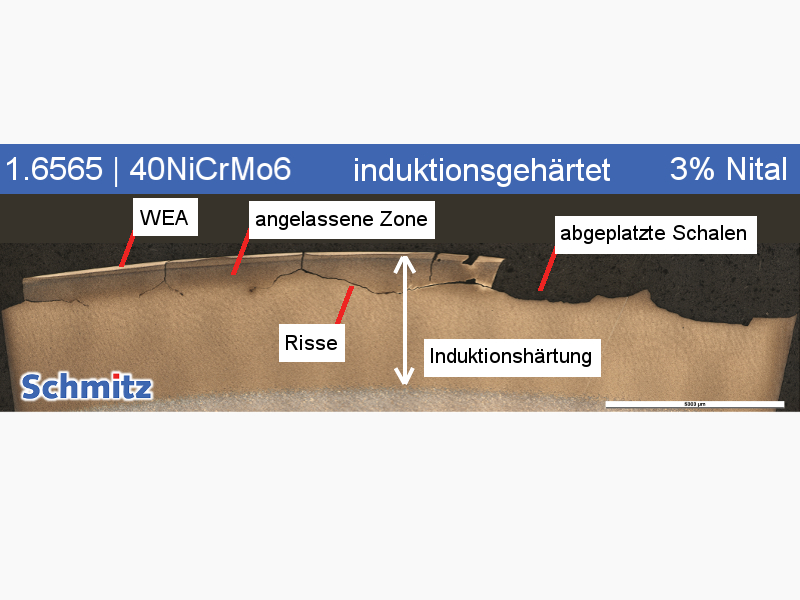
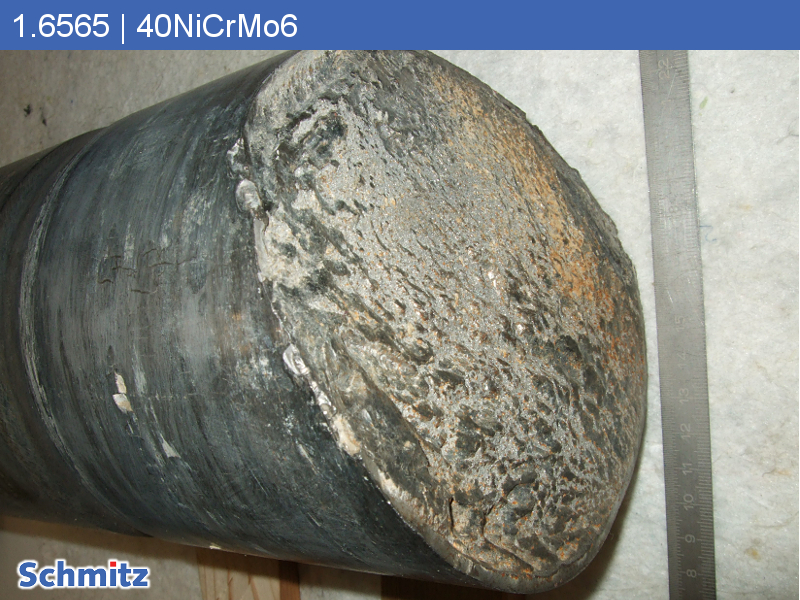
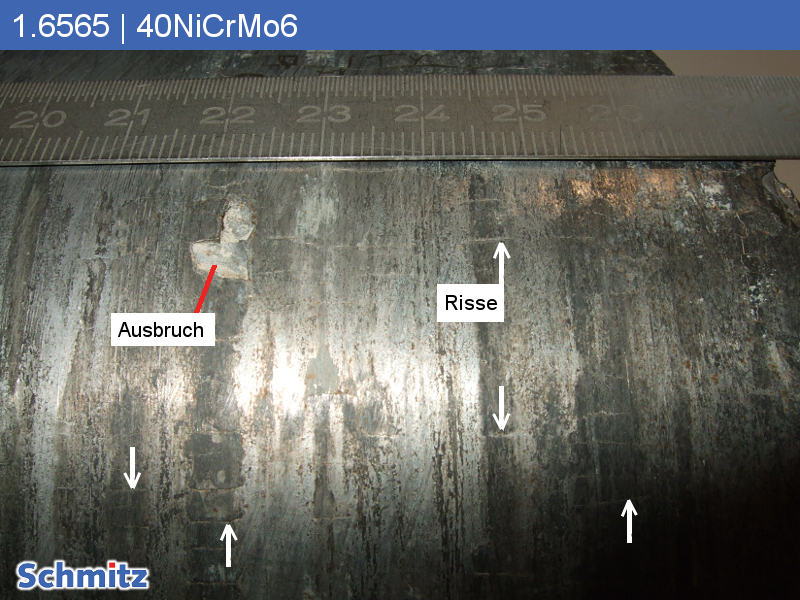
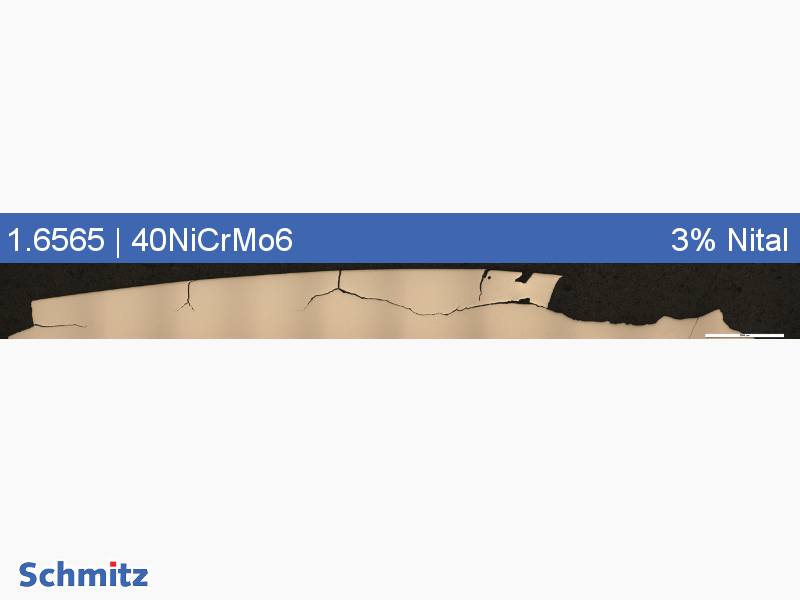
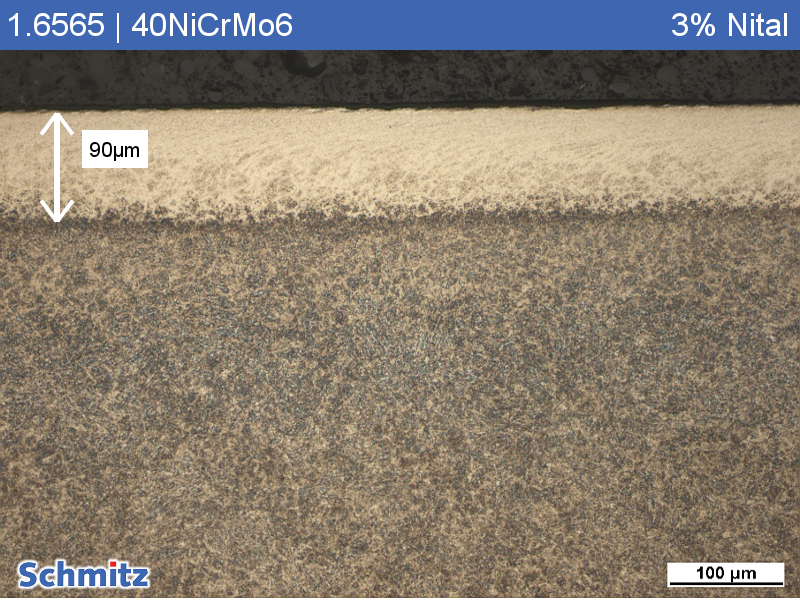
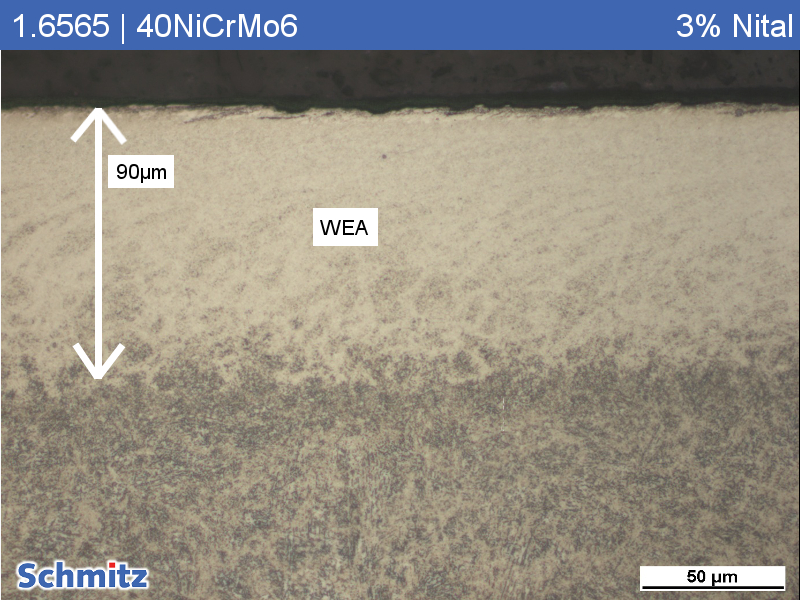
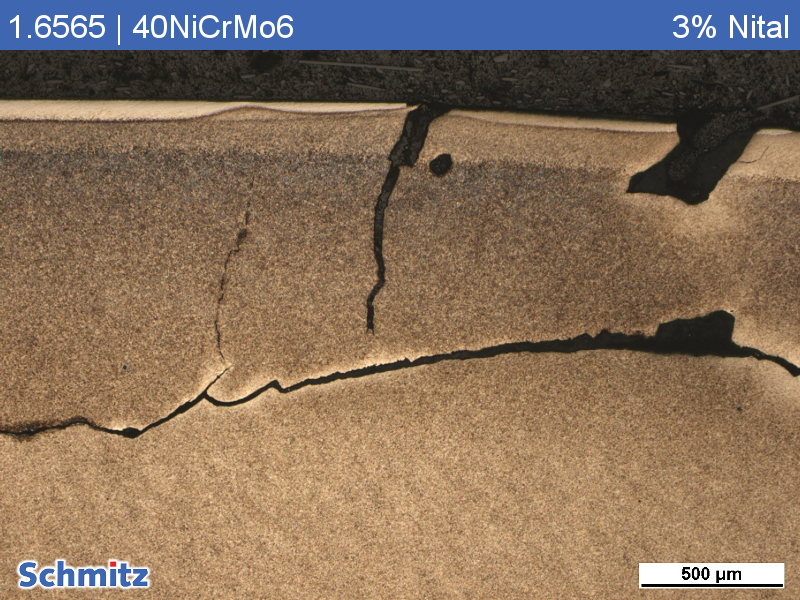
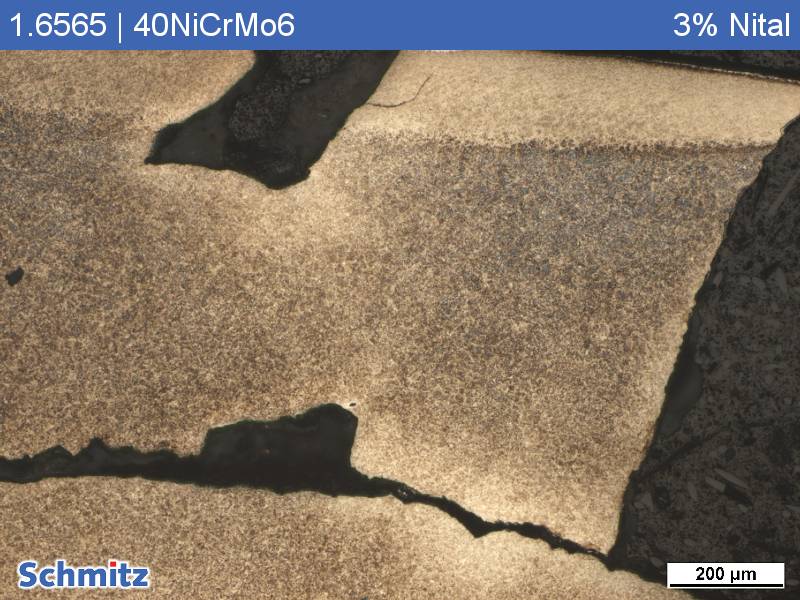
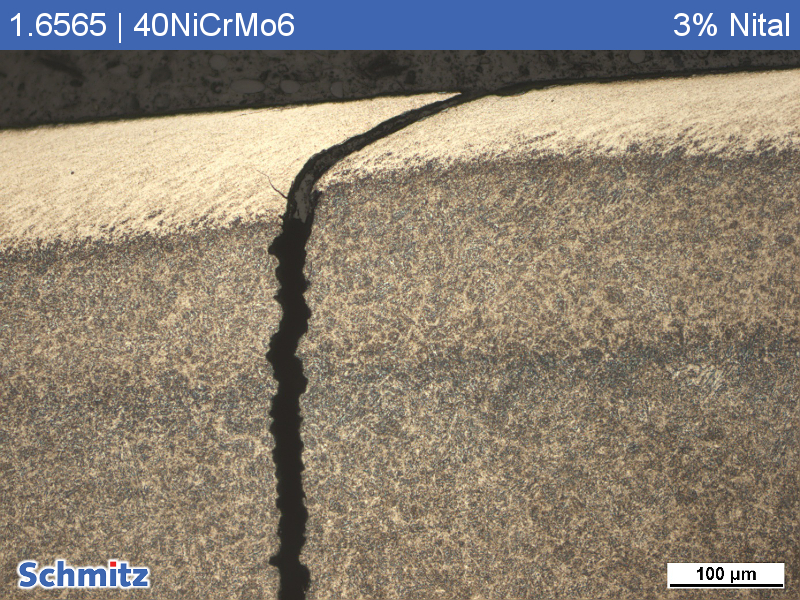
The microstructural images show a broken shaft from an impact hammer mill made of 1.6565, induction hardened. Numerous cracks with local surface spalling can be seen macroscopically in the area of the bearing seat. A new hardening zone of varying thickness has formed on the surface. This zone can only be etched weakly and remains almost white. This gave the white layer its name – the so-called white layer. This is friction martensite (tetragonal martensite).
This is caused by extreme friction, such as that which can occur due to slippage in the bearing seat. The hardness of this re-hardened zone is 761 HV 0.5. This thin, hard layer is very brittle. Cracks in the white layer act as sharp notches, which, due to the high dynamic loads, lead to a very small area of fatigue fracture. The residual fracture area is approx. 95% of the shaft cross-section.
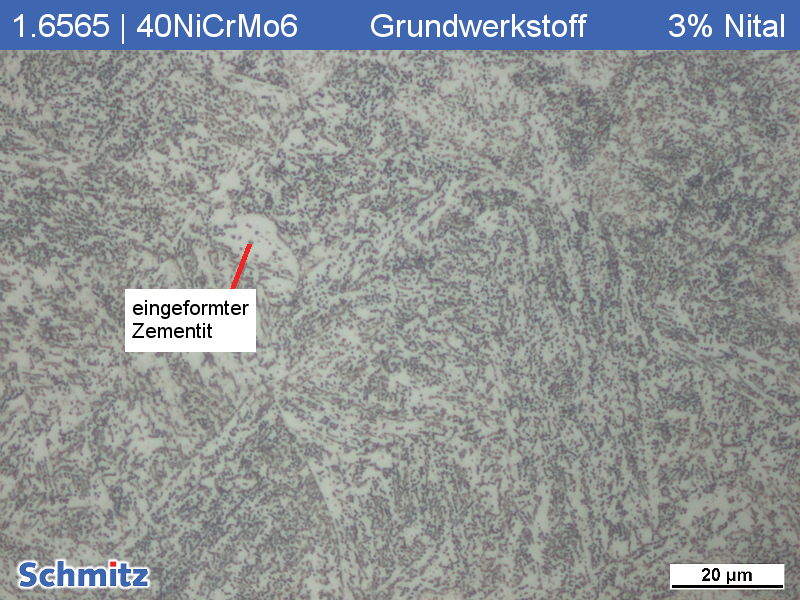
Below the friction martensite layer is an area that has been tempered due to the effect of heat (friction) (tempering zone). Here, the hardness of the induction-hardened edge zone drops to 473 HV 0.5. The hardness of the underlying, unaffected induction hardened layer is approx. 500 HV. The basic structure consists mainly of pearlite with partially formed cementite (249 HV 0.5).
Failure Cases
 S-1050-HDD Grinding burn in drill string
 15CrN6 | 1.5919 +A faulty soft annealing
 EN-GJS-500-7 | 5.3200 Production welding
 Breakage of a side cutter
 1.4462 | X2CrNiMoN22-5-3 Duplex with sigma phase
 1.6580 | 30CrNiMo8 +N + QT Forging crack
 1.4765 | X8CrAl25-5 AlN precipitations
 EN AC-43500 | AlSi10MnMg Cold run and hot crack
 1.0503 | C45 Incorrect induction hardened
 EN-GJS-500-7 | 5.3200 | Tool life problems in machining