
Grinding burn and white layers
| Chemical designation | Schleifbrand (White Layer) |
|---|---|
| State | Grinding burn and white layers |
| Etching | 3 % Nital |
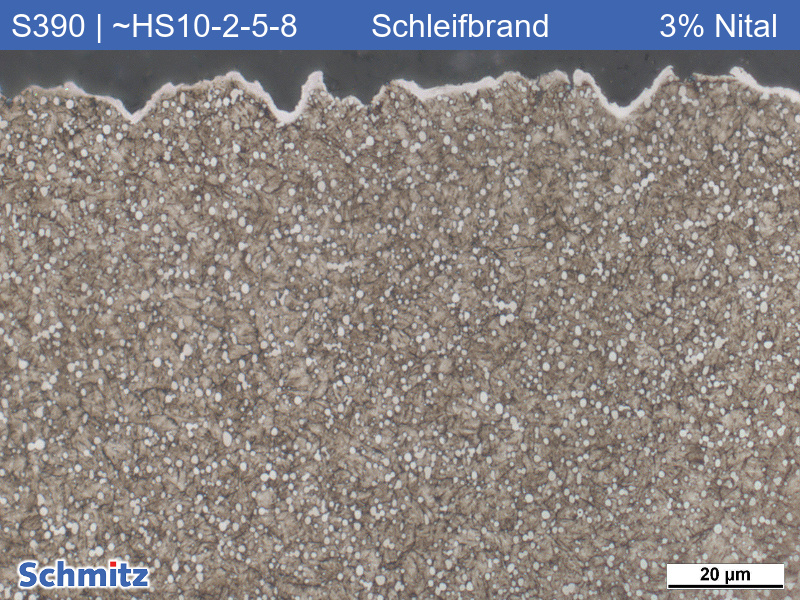
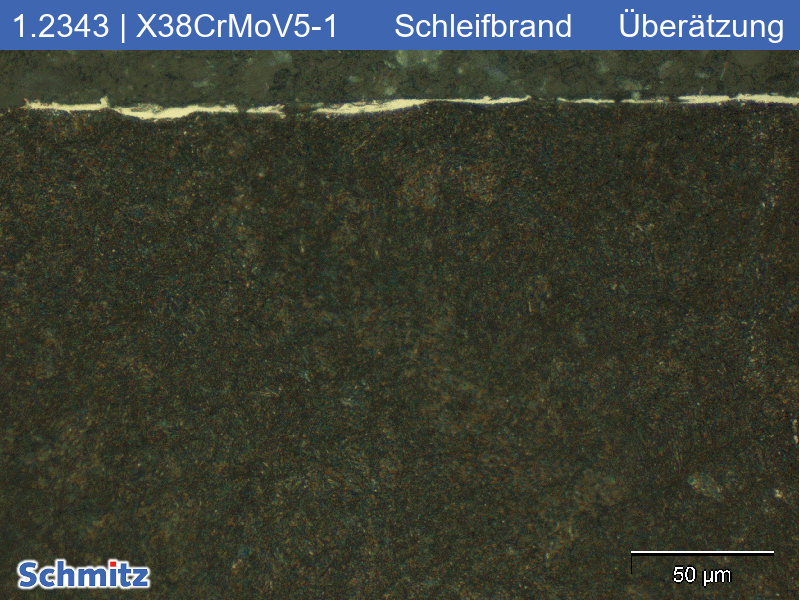
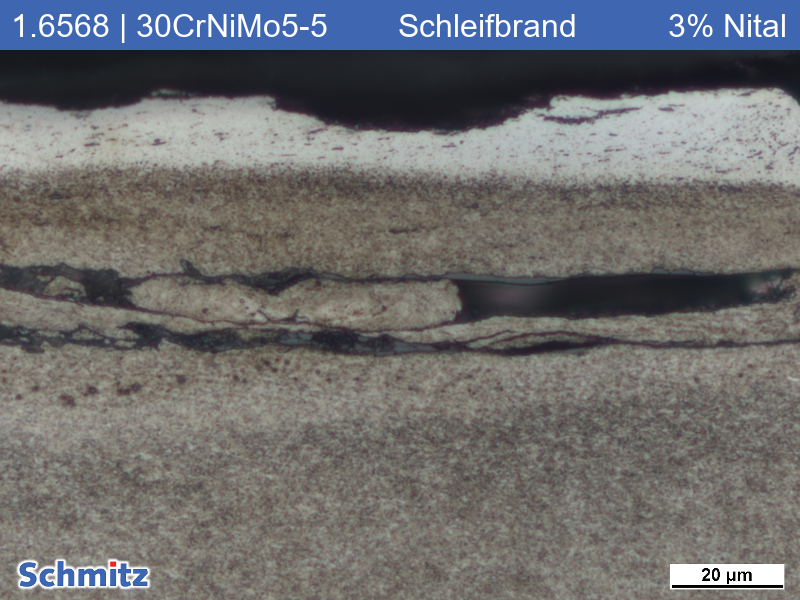
Grinding burn is thermal damage to the edge zone caused by excessive temperatures during the grinding process.
This can be caused by excessive contact pressure, a blunt grinding wheel, insufficient cooling or excessive cutting speed, for example. Comparable edge zone changes can also occur on the sample surface during other manufacturing processes (e.g. turning, milling, drilling, honing or wire erosion), for example in titanium with an edge zone modified by wire erosion (link).
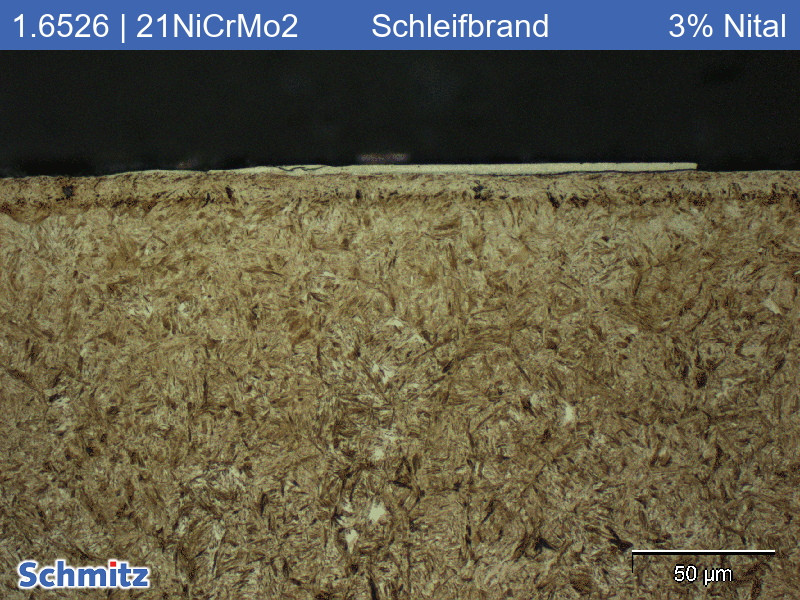
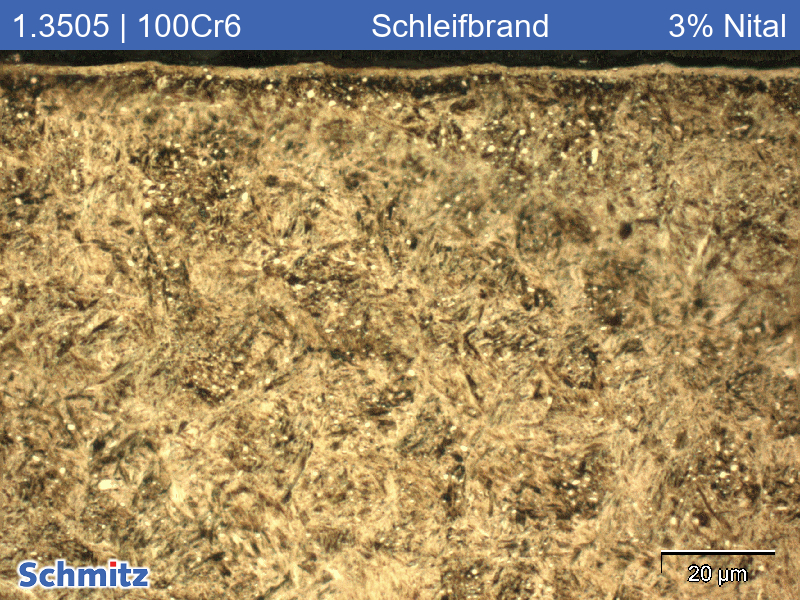
Local overheating can cause the austenitisation temperature of the material to be exceeded. As a result of the very rapid cooling by the surrounding base material, untempered martensite (and possibly residual austenite) forms, leading to local hardening of the surface. Directly below this re-hardened zone (also known as the white layer) there is often a tempered zone, which can be identified in the micrograph as a dark area with a drop in hardness.
If a temperature is reached during grinding that is below the hardening temperature but above the tempering temperature of the material, no new martensite is formed, but rather annealing zones close to the surface with a corresponding drop in hardness.
The formation of new microstructures can lead to internal stresses, which in turn promote undesirable crack formation.
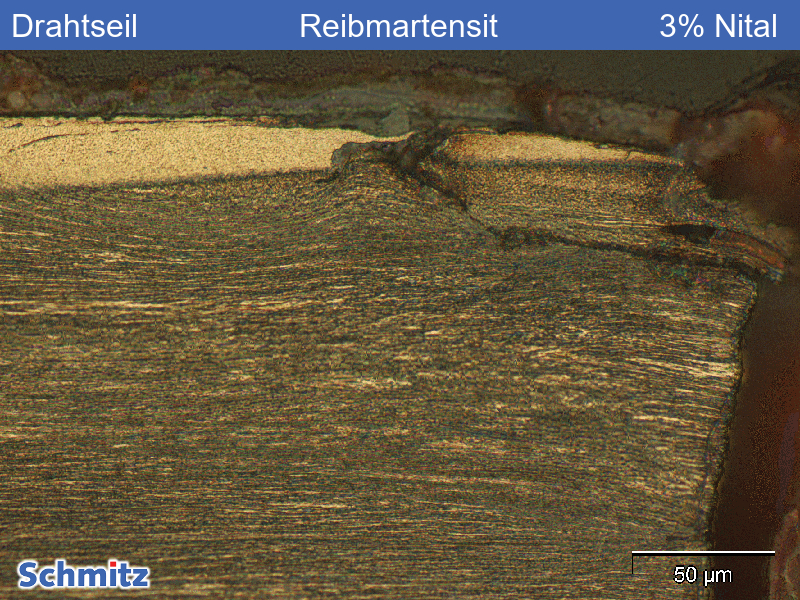
If martensite formation is predominantly friction-induced – i.e. through the interaction of high temperatures and severe plastic deformation as a result of friction – this is referred to as friction martensite. The white layer in grinding burn therefore often consists of friction martensite. While the term “grinding burn” describes the damage mechanism in manufacturing, “friction martensite” refers to the resulting microstructure or the underlying transformation mechanism.
Nital etching reveals the thermally affected surface layer, which is usually only a few micrometres thick: the very fine, strongly tetragonally strained and untempered martensite is only slightly etched and therefore appears light or white. Annealing zones, on the other hand, appear darker because they consist of tempered, lower-stress martensite with reduced tetragonal distortion.
Failure Cases
 S-1050-HDD Grinding burn in drill string
 15CrN6 | 1.5919 +A faulty soft annealing
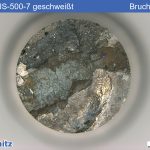 EN-GJS-500-7 | 5.3200 Production welding
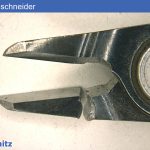 Breakage of a side cutter
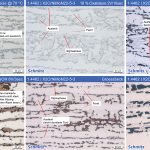 1.4462 | X2CrNiMoN22-5-3 Duplex with sigma phase
 1.6580 | 30CrNiMo8 +N + QT Forging crack
 1.4765 | X8CrAl25-5 AlN precipitations
 EN AC-43500 | AlSi10MnMg Cold run and hot crack
 1.0503 | C45 Incorrect induction hardened
 EN-GJS-500-7 | 5.3200 | Tool life problems in machining